Home Design & Listing Management Platform
Mero Ghar
Product Design • Real Estate • Product Planning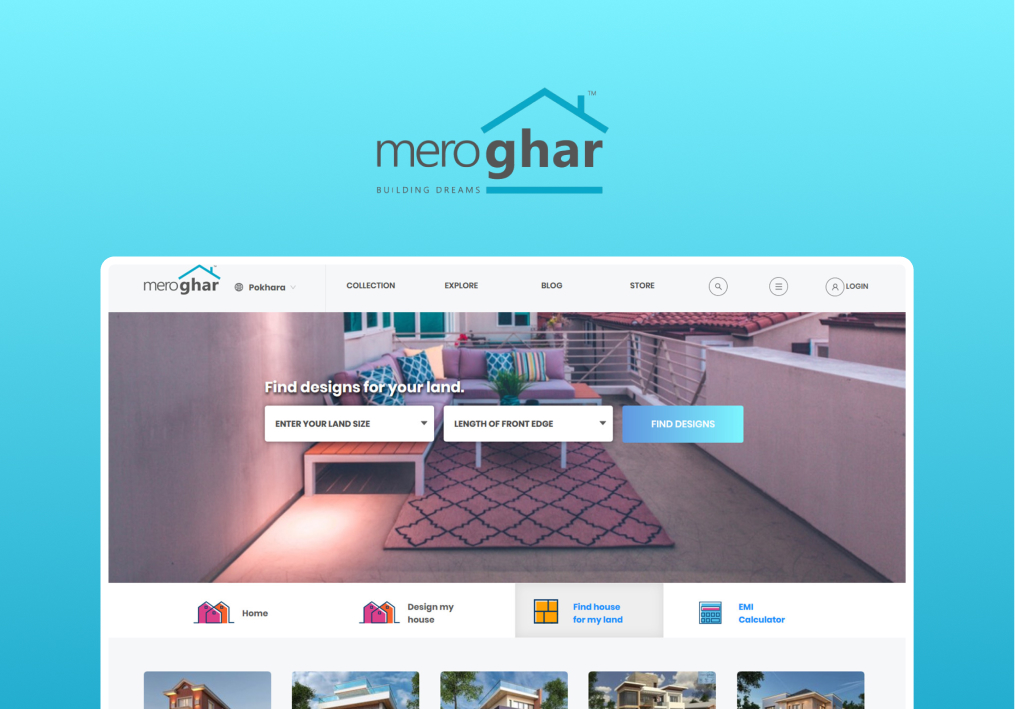
My Role
Product Scope
My Work Timeline
2021
Collaborators
- Sujan Devkota - Full Stack Developer
Overview
Mero Ghar is a Nepali home brand that matches ready-made house designs to a buyer's specific plot and then delivers the build turn-key — 'Find house for your land. Choose the design and we will handle the rest.'
Context
Mero Ghar is a home design and construction platform in Nepal that matches residential designs to a buyer's land and manages the build end-to-end. It positions itself as a "Home Expert" and, for the first time in Nepal, lets owners "find a house for your land" — filtering designs by plot size (in Aana) and frontage, then handling the construction.
My Role
As UI/UX Designer I owned the product experience — the flows that take a landowner from "I have a plot" to "here are designs that fit it," and on into a managed construction project — from research and IA through interaction and UI.
The Problem
Building a home in Nepal is daunting: owners juggle architects, contractors and approvals with no easy way to know which designs even fit their land, and little confidence in timeline, cost or structural quality. The traditional process is fragmented, opaque and intimidating for a first-time builder.
What I Did
- Designed land-first design discovery — the core flow filters house designs by the plot's size and frontage, so every option a user sees actually fits their land.
- Made "we handle the rest" tangible — designed the turn-key journey from picking a design to a managed construction project, keeping a complex, months-long process feeling simple.
- Surfaced trust signals — foregrounding earthquake-resistant, energy-efficient designs and accelerated timelines, the reassurances that matter most to a hesitant first-time builder.
- Reduced decision overload — curating styles into a guided choice rather than an open-ended catalogue.
Outcome
Mero Ghar shipped as a platform that turns an intimidating, fragmented building process into a guided one — "choose the design and we will handle the rest" — letting Nepali landowners find a fitting home design and move into a managed build with far less friction.
Reflection
The interesting constraint was emotional, not functional: this is one of the largest decisions a person makes. The design had to earn trust at every step, which meant leading with reassurance and clarity over feature breadth.