Crowdsourced Platform for Artists
Butta
My Role
Creative Director
My Work Timeline
Sep 2016 - Dec 2019
Recognition
Startup Weekend Winner 2015
Impact
120+
Artists
500+
Artworks
50% of profit
Artist share
Overview
Butta, a spin-off from Threadpaints, was a crowdsourced platform that let artists earn from their work by selling it on custom-made merchandise. Butta handled production, marketing and distribution while sharing the profits with the creators. At our peak we catered to 120+ artists and 500+ artworks.
The Idea
While running Threadpaints, designers kept approaching us with artwork they wanted to put out into the world — but they had no easy way to produce, sell or get paid for it. Rather than fold those submissions into Threadpaints, I built Butta as a separate platform dedicated to that exact problem: a place where any artist could turn a design into merchandise and earn from it, without needing to start a brand of their own.
We pitched the idea at the NEHUB Startup Weekend and won — three days of building the concept with a serious team turned a side idea into a real venture.
My Role
I founded Butta and served as its Creative Director and CEO. I shaped the brand, the platform experience and the creative direction of every campaign, and I designed the model that decided how artists submitted, how work got selected, and how creators got paid.
How It Worked
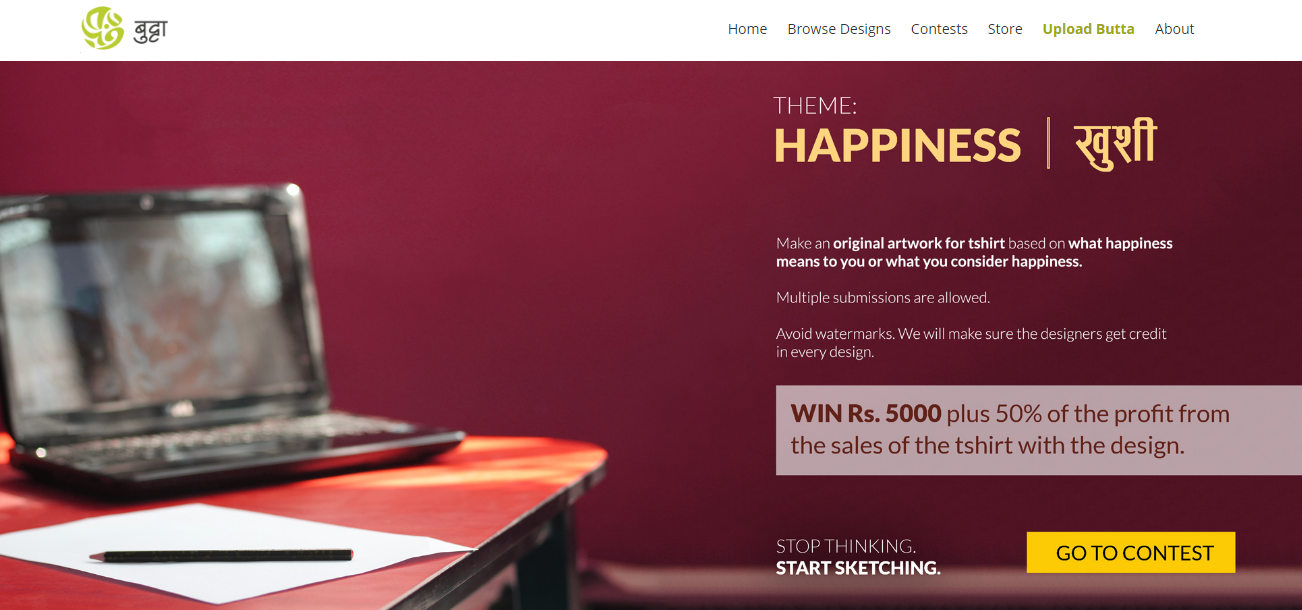
Butta worked as an open platform for artists: submit a design, and if it sold, the creator earned a cut — 50% of the profit, alongside a per-unit payout on each t-shirt sold — while Butta handled the entire pipeline from production to delivery. We ran themed design contests (such as "Happiness / खुशी") to surface new work, and expanded from t-shirts into tote bags, notebooks and other merchandise. We also took on bulk corporate orders, pairing merchandise production with branding and marketing.
As the platform grew, we learned hard lessons about design plagiarism on fully open submissions, and evolved toward a more curated model — directly approaching and commissioning artists while still keeping the door open for submissions.
Impact
At its peak, Butta gave 120+ artists a way to earn from their craft and brought 500+ artworks to market — putting independent Nepali design onto products people actually wore and used. It became a recognised name in Nepal's creative-entrepreneurship scene and a model for how artists could make a living from their work.